The Constellation Is Not a Star Cluster
A constellation is a pattern seen from Earth, not necessarily a star cluster. Learn how distance, perspective and a simple sky map explain the difference.
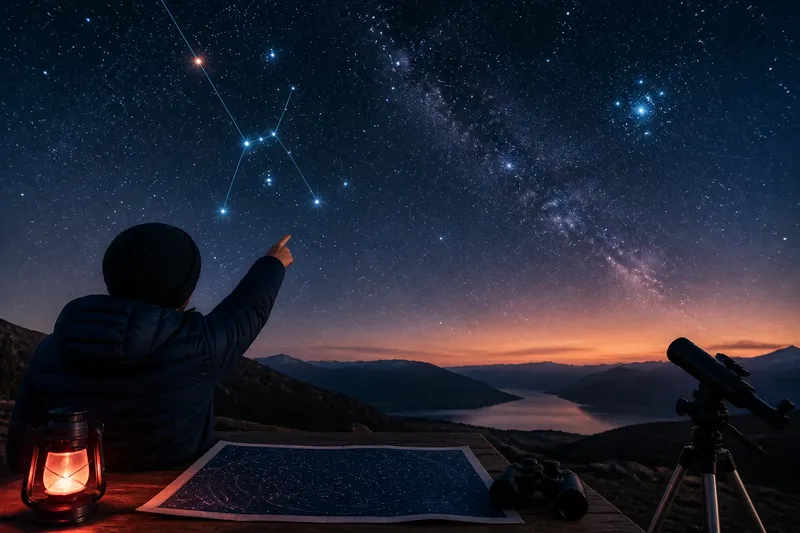
On a clear evening, Orion’s three belt stars look like neighbours lined up for inspection. The constellation is easy to recognise, but its stars are not necessarily close to one another in space. A constellation is a pattern seen from Earth; a star cluster is a physical gathering of stars.
That distinction is easy to lose when a printed map joins bright points with neat lines. The lines help the eye remember a shape. They do not mark a boundary in space, and they say nothing by themselves about how far apart the stars are.
What does a constellation actually show?
A constellation is a named region of the sky, commonly identified by a familiar arrangement of stars. From the ground, the stars appear against the same dark background, so the eye reads them as parts of one figure. Their apparent closeness is an effect of looking in roughly the same direction, not evidence that they share a neighbourhood.
Think of distant streetlights seen from the end of a straight road. Several can seem to stand side by side, though one may be much farther away than another. The sky adds a vast depth behind its flat-looking display, while the observer receives only the direction from which each star’s light arrives.
Constellation outlines are conventions. Different maps may connect the same stars in slightly different ways, or leave some points out. The International Astronomical Union’s constellation boundaries, used to divide the whole sky into named regions, are separate from the familiar stick figures. Neither the boundary nor the drawing is a physical enclosure.
Why does a sky map flatten the stars?
A map shows where objects appear on the celestial sphere: an imaginary shell surrounding Earth. It is useful for finding things because it records direction. Like a road map, it cannot show every feature of depth in the same visual language.
Stars within one constellation can sit at very different distances from Earth. Two that appear close together on a chart may be far apart from each other, while stars that are physically closer to one another may appear in entirely different parts of the sky. Their angular separation tells you how far apart they look from our viewpoint, not their true separation through space.
This is why a constellation drawing should be treated as a finder’s aid. It can help you point towards a star or recognise a region, much as the shape of a coastline helps you locate a bay. The resemblance on the page is not a claim about the underlying structure.
How can you tell a constellation from a star cluster?
A star cluster is a group of stars held together by gravity, or stars that share a common origin and move through space as a related group. Its members are genuinely associated, though their spacing and appearance vary. A constellation, by contrast, is defined by how stars appear from Earth and can include unrelated stars at different depths.
The difference is not always obvious to the unaided eye. A cluster may look like a small patch of extra stars, while a constellation can span a wide area. Use the object’s name and a reliable sky map or astronomy app to check what you are looking at. The Pleiades, for instance, is a star cluster found within the constellation Taurus; Taurus itself is a much larger sky region containing stars that do not all belong to the cluster.
There are several kinds of clusters, including open clusters and globular clusters. Open clusters are generally seen as looser groupings, while globular clusters appear as dense, rounded concentrations. Those descriptions concern the physical arrangement of stars, not the connecting lines in a constellation diagram.
What can apparent star patterns tell you?
They tell you where to look, and they make the sky easier to remember. A recognisable outline can help you find a neighbouring constellation, trace a seasonal route across the sky, or identify a bright star before checking its name. That practical value does not depend on the stars being physically connected.
Patterns also reveal how much perspective shapes what we see. The same stars would form a different arrangement if viewed from another part of the galaxy. From Earth, Orion’s belt looks like a tidy row; from a different vantage point, that alignment would loosen or change. The pattern belongs to a particular line of sight.
Say you are outside with a paper chart and want to locate the Pleiades. You first identify Taurus by its broad outline, then compare the chart’s marked cluster with the compact patch in the sky. The expected result is a useful distinction: Taurus gives you the direction, while the Pleiades is the associated group of stars you are seeking. The chart’s lines remain pointers, not cosmic ties.
How do distance and perspective answer common questions?
Are the stars in a constellation near each other?
Not necessarily. Some may be relatively close in space, while others lie much farther away; their shared appearance from Earth does not establish a physical connection.
Can stars in one constellation belong to different groups?
Yes. A constellation can contain individual stars, star clusters and other celestial objects that are unrelated to one another. It is a named region of the sky, not a membership list for a single stellar family.
Is Orion’s Belt a star cluster?
No. Orion’s Belt is the familiar alignment of three bright stars within the constellation Orion. Its neat appearance is an apparent pattern, not the definition of a cluster.
How can I check whether a group is a real cluster?
Look up the object’s name in a dependable star atlas, planetarium app or astronomy reference, and check whether it is identified as a cluster. A naked-eye resemblance alone cannot show whether stars share a physical association.
What should you notice at the eyepiece?
When viewing with binoculars or a telescope, separate the pattern you used to find an object from the details the instrument reveals. A wider view may show how a cluster sits within its constellation, while magnification can make individual stars easier to distinguish. Neither view turns the whole constellation into a cluster.
It can help to keep two questions apart: “What shape does this make from here?” and “Which stars are physically related?” A sky chart answers the first well. Identifying a cluster requires information beyond the drawing, such as the object’s classification and the stars’ shared properties.
Some stars that look close on a map may also be double or multiple stars, with a genuine physical relationship; others only overlap from our viewpoint. Their appearance alone does not settle the question. For a beginner, the useful habit is simply to treat chart lines as visual shorthand and check the object’s classification when physical membership matters.
The next time a constellation catches your eye, let the outline do its quiet work as a signpost. Then remember that its stars occupy different depths, and that the sky’s flat drawing is only one view of a much deeper arrangement. The constellation is not a star cluster; it is a way to recognise a patch of sky from here.