Why the Moon Keeps Changing Its Shape
Why the Moon keeps changing its shape is really a question of viewing angle. Learn the lamp model and read each phase without mistaking it for shadow.
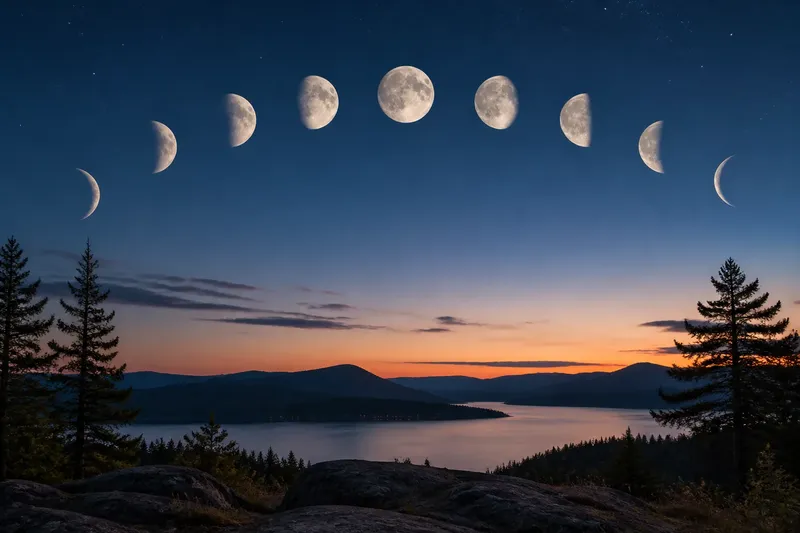
On a clear evening, a thin Moon hangs above the roofs, its bright edge turned towards a patch of fading sky. A few nights later, it looks broader; later still, it may be round and bright. Why the Moon keeps changing its shape is less mysterious than it appears: the Moon stays round, while the portion of its sunlit half that faces us changes as it travels around Earth.
The easiest way to see this is to compare three approaches. You can picture an observer moving around a lamp, connect the picture to the Moon’s actual orbit, or use the phases as a way to orient yourself in the sky. The first explains the geometry, the second corrects the model’s limits, and the third makes the pattern useful outdoors. None requires the Moon to be changing shape, or Earth’s shadow to be doing the regular work.
How does the lamp model explain the phases?
Imagine an observer standing in the middle of a dark room with a small lamp held at arm’s length. The lamp stands for the Sun. A ball held farther away stands for the Moon. Light from the lamp illuminates half the ball at any moment, just as sunlight lights one half of the Moon. The observer’s view of the ball changes as they turn or move around it.
When the ball sits between the observer and the lamp, its lit side faces mostly away from the observer. Little of that bright half can be seen, so the ball appears dark or nearly dark. This corresponds to new Moon. As the ball moves around the observer, a narrow part of its illuminated side comes into view. The bright sliver grows into a crescent, then a half-disc, then a fuller shape.
On the far side of the observer, the ball’s sunlit half faces towards them. It appears full. As it continues around, the visible lit portion shrinks, passing through another half-disc and a waning crescent before returning to new Moon. The lamp has not started shining more strongly, and the ball has not grown. Only the arrangement of lamp, ball and observer has changed.
The model is most useful when you keep one rule in mind: the lit half always faces the lamp. The phase is the part of that half visible from the observer’s position. A crescent is not a curved shadow creeping across the Moon. It is the bright side seen at a slant, with the rest of the round surface still present but not brightly lit by the Sun.
What changes when you connect the model to the real sky?
In the real arrangement, the Sun is the light source, Earth is the observer’s home, and the Moon moves around Earth. The Moon also rotates, but its familiar phases follow its position in orbit, not a change in the amount of sunlight it receives. From Earth, we see different fractions of its sunlit hemisphere during a repeating cycle.
The lamp model simplifies distance and scale. A room makes the lamp, ball and observer look close together, while the real Sun is far away and sunlight reaches the Moon from nearly the same direction across its surface. You do not need to reproduce the astronomical distances to understand the important geometry. The Sun lights one lunar hemisphere; your viewing angle determines how much of that hemisphere you can see.
New Moon occurs when the Moon is in roughly the same direction as the Sun in our sky, so its illuminated side largely faces away from us. It is usually difficult to see against the bright daytime sky, though the exact alignment varies. At full Moon, Earth lies roughly between the Sun and Moon, and we face nearly all of the Moon’s sunlit side.
“Roughly” matters. The Moon’s orbit is tilted relative to Earth’s path around the Sun, so the three bodies do not usually line up exactly at new or full Moon. That is why an ordinary new Moon does not make the Moon’s shadow fall on Earth, and an ordinary full Moon does not enter Earth’s shadow. A solar or lunar eclipse needs a more exact alignment.
Earth’s shadow is involved during a lunar eclipse, but that is a separate event, not the cause of the regular phases. If the Moon’s changing appearance were mainly caused by Earth’s shadow, we would expect that shadow to cover it repeatedly as it circles us. Instead, the Moon’s surface remains lit in a way that changes gradually from our viewpoint, night after night.
Which approach suits the way you want to learn?
The lamp-and-ball model is best if you want a clear explanation at home. It gives you something physical to turn and makes the changing view easier to grasp than a diagram alone. Its weakness is that a small indoor set-up can make the geometry seem cramped, so treat it as a model of directions, not a scale drawing.
Looking at the Moon over several evenings suits someone who wants the explanation to become a recognisable pattern. Notice where the bright edge lies, how much of the disc is lit, and roughly where the Moon sits relative to the setting Sun. The view makes the changing phase tangible, though clouds, buildings and the Moon’s changing rise time can interrupt the sequence.
A labelled phase diagram or a planetarium app suits a reader who wants to connect the Moon’s appearance with its position in orbit. It can show why the Moon is sometimes visible in daylight and why a crescent appears near the Sun in the sky. The diagram is efficient, but it can turn a spatial idea into a set of labels if you never compare it with the real Moon.
Say you see a thin crescent shortly after sunset and want to know why the bright edge faces one way. You could hold a ball in a dim room, point a lamp at it from the same general direction as the Sun, and move your head until the ball matches the sky’s view. The expected result is that the lit side points towards the lamp while the visible bright sliver changes with your position. That simple match is the useful part; the room’s distances are not.
What do the phase names tell you?
The phase names describe how much of the visible lunar disc appears illuminated and whether that bright portion is growing or shrinking. “Waxing” means the visible lit area is increasing; “waning” means it is decreasing. “Crescent” describes a slim lit portion, while “gibbous” means more than half the disc is lit but it is not full.
- New Moon: the Moon’s sunlit side mostly faces away from Earth, making it hard to see.
- Waxing crescent: a growing sliver of the lit side becomes visible.
- First quarter: about half of the visible disc is illuminated, with the lit area growing.
- Waxing gibbous: more than half is lit, and the bright portion is still growing.
- Full Moon: nearly the whole Earth-facing disc appears illuminated.
- Waning gibbous: the visible bright area is shrinking after full Moon.
- Last quarter: about half the disc is lit again, now on the waning part of the cycle.
- Waning crescent: a narrowing sliver remains before new Moon.
“Quarter” refers to the Moon’s progress around Earth, not to a quarter of its disc being lit. At first quarter and last quarter, the visible disc is roughly half illuminated. The names are a small reminder that phase descriptions refer to where the Moon is in its cycle, not only to the shape seen from the ground.
Why does the Moon appear at different times?
The Moon’s phase and its time in the sky are linked because both depend on its position relative to Earth and the Sun. A new Moon lies near the Sun’s direction, so it tends to rise and set at roughly similar times to the Sun. A full Moon lies opposite the Sun in the sky, so it is generally up through much of the night. Between those points, its rising and setting times shift gradually.
This is a broad pattern, not a promise that the Moon will be easy to spot at any chosen hour. Its path across the sky, the season, local horizon and cloud cover all affect what you can see. A crescent near sunset may be low and brief; a Moon seen in daylight can be perfectly ordinary, particularly around the quarter phases.
To follow the pattern, look from the same place on a few evenings and note the phase, direction and approximate time. A notebook is enough; a phone’s sky map can help identify where to look, but the Moon itself is the better reference for the phase. You will see that the bright portion changes steadily, while the Moon’s position at a given clock time shifts too.
What do people often ask about lunar phases?
Does Earth’s shadow make the crescent Moon?
No. The crescent is the part of the Moon’s sunlit hemisphere that faces Earth. Earth’s shadow crosses the Moon during a lunar eclipse, not during the ordinary monthly cycle.
Why can I see the Moon during the day?
The Moon is often above the horizon in daylight, and its sunlit surface can be bright enough to see against the sky. Whether it stands out depends on its phase, position, the sky’s brightness and your view of the horizon.
Why does the Moon’s bright side face the Sun?
Sunlight travels from the Sun to the Moon, illuminating the hemisphere turned towards it. The visible bright edge follows that geometry, although the Moon’s curved surface and your viewing angle make the boundary appear rounded.
Does the Moon change phase because it rotates?
No. Its rotation keeps nearly the same lunar face turned towards Earth over time, but the phases come from its orbit around Earth. As its position changes, we see a different fraction of the sunlit half.
What is the simplest way to choose an explanation?
Choose the lamp model if the geometry is the part that feels slippery. Choose repeated observation if you want to recognise the cycle in the sky, or a diagram or app if you want to relate phase to orbital position quickly. Each approach answers a slightly different question, and together they make the familiar sequence easier to read.
The next time a crescent appears over a roofline, look for the Sun’s direction before asking what has been covered. The Moon is still a round world with one half in sunlight; your place in the arrangement is what has changed. That small adjustment turns a changing shape into a changing view.