Binoculars or Naked Eye? Two Ways to Meet the Night Sky
Binoculars or naked eye: learn how each changes the view, what binoculars can reveal about the Moon and star fields, and how to choose for your target.
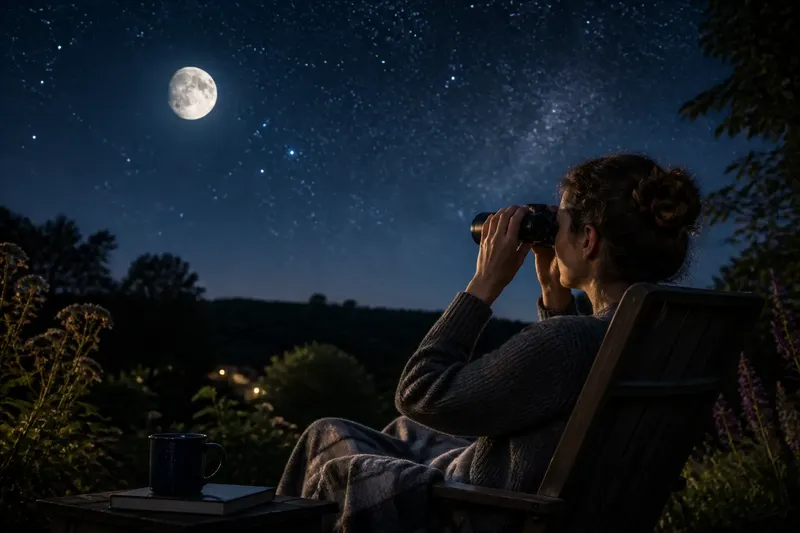
You settle into a garden chair, look up, and find the Moon bright enough to wash out nearby stars. Binoculars or naked eye is not a contest: each view answers a different question, from how a constellation fits together to what lies close to a bright object.
The distinction is less about magnification than about field of view and comfort. Your eyes take in the larger scene; binoculars isolate a patch and make its details easier to inspect. Switching between them is useful, but so is knowing when one view has little to add.
What does the naked eye show best?
Unaided sight gives you the sky’s broad geometry. You can follow a constellation’s outline, see how it sits relative to the horizon and neighbouring patterns, and notice the Moon’s changing position from one evening to another. That context is easy to lose when looking through a narrow field.
It is also the simplest way to judge conditions. Thin cloud, a bright Moon or nearby lighting can make faint stars hard to pick out. Before reaching for binoculars, take in the whole patch with your eyes. If only the brightest stars are visible, a closer view may add detail, but it cannot restore stars hidden by cloud or glare.
What do binoculars add to a night-sky view?
Binoculars reveal more stars in a selected area and can make compact patterns easier to examine. They are useful for tracing a route from a bright star to a nearby group, or for seeing the Moon’s larger surface features more distinctly than with the naked eye. The trade-off is a smaller field: the detail arrives without as much surrounding context.
They do not turn every faint object into an obvious one. Hand-held movement, focus, eyesight and sky conditions all affect what remains clear. A steady, comfortable view matters more than selecting the most powerful instrument in reach. If the image is difficult to hold still, a less magnified view may be more informative.
How should you compare the two views?
Start by looking with unaided eyes and choose one recognisable feature: the Moon’s edge, a bright star or a simple line of stars. Raise the binoculars while keeping your gaze on that feature. Look for one specific detail, then lower them to recover the wider pattern.
Imagine you are watching the Moon from a back garden, and its bright disc makes a nearby group of stars hard to distinguish. First, you note where the Moon sits among the wider sky without equipment. Next, you bring focused binoculars to the Moon and inspect its visible markings. Then you lower them and check how the Moon relates to the surrounding sky. The result is a closer view of the lunar surface paired with the context that the binoculars cropped away; if the view shakes, you can rest your elbows on the chair arms and try again, or stay with the steadier naked-eye view.
What if the binocular view is uncomfortable?
A few basic adjustments can resolve common annoyances, though persistent discomfort is a reason to stop rather than press on.
- The image wobbles: Check whether your elbows are unsupported. If they are, sit down and rest them on your chest or chair arms; if it still shakes, lower the binoculars and use your naked eyes for that target.
- The two circles do not merge: Check the spacing between the eyepieces. If the view remains split, adjust the eyepiece spacing according to the maker’s instructions; if it still feels wrong, stop and check the manual rather than forcing the instrument.
- A bright star looks blurred: Check focus on that star using the binoculars’ controls. If it sharpens, continue; if it does not, check the instructions for separate eye adjustments or return to unaided viewing.
- You cannot locate the target: Check whether you can identify a nearby bright star without the binoculars. If you can, centre on it and make small movements; if you cannot, choose a more obvious target rather than sweeping the lenses blindly.
- The view seems crowded: Check whether the chosen patch contains more stars than you can easily sort. If so, lower the binoculars to recover the pattern’s outline; if that remains unclear, pick out one bright star and inspect only its immediate surroundings.
- Faint stars are missing: Check for thin cloud, Moon glare or a nearby light. If one is affecting the view, wait for a clearer patch or turn away from the local light if safe; if conditions remain bright, choose a target that does not depend on faint stars.
- Your eyes feel strained: Check whether you are squinting or holding the binoculars too long. If so, take a break and look unaided; if discomfort continues, end the session.
Which view suits the Moon, planets and star patterns?
The naked eye is best for placing a bright object in its broader setting and following a constellation’s shape. Binoculars can make the Moon’s surface easier to inspect and reveal additional stars in a compact region. Bright planets remain easy to identify without equipment; binoculars may show their surroundings, but they should not be mistaken for a telescope’s close planetary view.
For a broad constellation, begin unaided. For a bright target whose immediate surroundings interest you, try binoculars. If clouds or local lights are dominating, neither view will overcome them, and a simpler target is the sensible choice.
What do readers ask about binoculars or naked eye?
Can I learn constellations without binoculars?
Yes. The naked eye gives the wide field needed to recognise how bright stars form larger patterns. Binoculars can help examine a portion, but they can also remove the surrounding stars that make the outline recognisable.
Can binoculars show detail on the Moon?
They can make larger lunar surface features easier to distinguish than unaided sight. Hold the view steadily and use the focus controls; if the image remains uncomfortable or blurred, follow the manufacturer’s instructions rather than forcing the adjustment.
Why can I see fewer stars through binoculars?
The narrow field can make a rich star field feel crowded, and movement or poor focus can hide detail. Lower the binoculars to recover the wider pattern, then return to a bright, recognisable point if you want to inspect a smaller area.
Should I use an app while observing?
An app such as Stellarium can help identify a bright object or check a pattern, but a lit screen competes with the night sky. Use it briefly and keep the display dim; a simple printed chart is another option.
When should you switch between the views?
Use unaided sight to choose a target and understand its place in the sky. Bring up binoculars when you have a particular detail to inspect, then lower them to see how that detail fits back into the larger scene. This is a useful way to approach binoculars or naked eye without treating either as the default for every object.
For the Moon, begin with the naked-eye view if you want its position and brightness in context; use binoculars if you want to examine its larger surface markings. For a constellation, reverse the emphasis: learn its outline unaided, then look closer only if a particular star field catches your attention. The choice can change from one glance to the next, which is a perfectly adequate observing plan.