When the North Star Became a Wayfinder
When the North Star became a wayfinder, Polaris offered travellers a steady northern reference; learn how its position, motion and limits make sense.

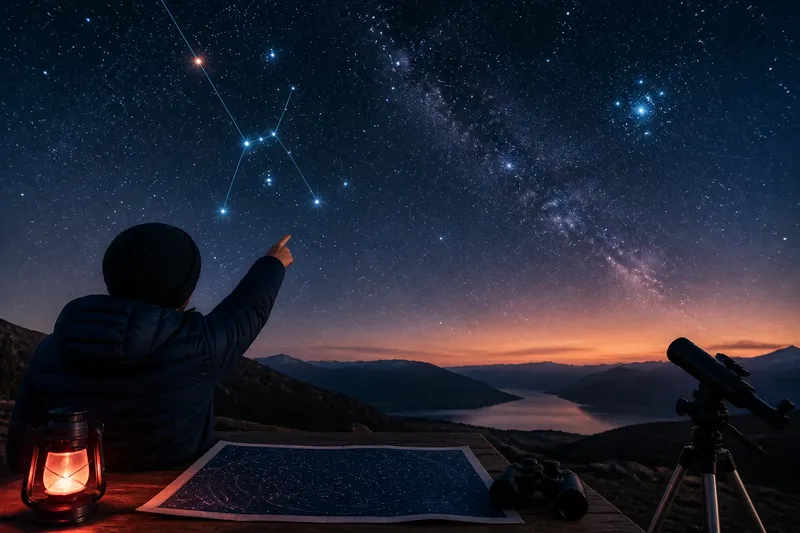
On a clear evening, a traveller pauses beside a dark track and turns a paper map beneath a torch. The North Star is visible above the trees. When the North Star became a wayfinder, it was not because Polaris stood perfectly still, but because its position near the north celestial pole made it a useful reference for people looking north.
To see how that practical relationship works, imagine a wholly invented situation: Mara has walked beyond the last marked junction on a northern moor. Her map is still readable, but she has lost her sense of direction. She can see the Plough, the familiar group of stars in Ursa Major, and a clear patch of sky beyond it. What she does next is simple; what the sky is doing is not.
How does Mara find Polaris?
Mara first identifies the Plough, also called the Big Dipper in North America. Its seven bright stars form a saucepan-like shape, though the handle may point in a different direction depending on the season and hour. She ignores the handle and uses the two stars at the outer edge of the bowl, Dubhe and Merak.
She traces an imaginary line from Merak through Dubhe and continues it outwards. That line leads towards Polaris, the bright star at the end of the Little Dipper’s handle in Ursa Minor. The smaller pattern can be faint, so Mara does not need to see the entire Little Dipper to use the pointer stars.
Polaris is not the brightest star in the sky. Its usefulness comes from where it appears, not from outshining its neighbours. Mara faces it and has found approximately north. She turns her map until its north edge points towards the star, then checks whether the track and surrounding features fit the map. The sky has supplied a bearing, not a complete navigation service.
Why did Polaris become a useful guide?
The Earth rotates, so stars appear to travel across the night sky. Most seem to rise in the east and set in the west. Polaris, however, lies close to the point in the northern sky where the Earth’s rotation axis points. As the sky appears to turn, Polaris traces a small circle around that point rather than sweeping far across the sky.
That makes Polaris a convenient visual anchor. If a traveller can identify it, the star indicates the direction of geographic north more consistently than stars farther from the pole. It also gives a rough sense of latitude: in the northern hemisphere, the height of the north celestial pole above the horizon corresponds approximately to the observer’s latitude. A person need not calculate that relationship to use the star as a compass-like reference.
For Mara, the immediate result is modest and observable. After aligning the map, she recognises that the track runs west rather than north. She can now choose the right fork at the next marker. Polaris has not told her where she is, how far she has travelled or whether the path is safe. It has helped her orient the map.
Is Polaris actually motionless?
No. Its apparent steadiness is a matter of viewpoint and scale. Earth spins on its axis, making the stars seem to circle overhead. Polaris appears nearly fixed because it sits close to the axis’s northern extension, but it is not exactly on the celestial pole. Over the course of a night, it makes a small circle around that point.
There is also a slower change. Earth’s rotation axis gradually changes its direction, like a slowly turning top. This motion, called axial precession, shifts the position of the celestial poles against the background stars over long spans of time. Polaris is therefore a useful pole star for our present era, not a permanent marker assigned to Earth.
The star itself is moving through space as well. That motion is not what makes it appear to circle nightly; the nightly pattern comes chiefly from Earth’s rotation. Separating the motions matters because “the North Star stays still” is a helpful shorthand only if it is not mistaken for a literal description of the cosmos.
What can a pole star tell you?
Does Polaris point to true north?
It indicates north closely, but not with perfect precision, because Polaris is offset from the north celestial pole. For casual orientation, that distinction is usually small; for precise navigation, use appropriate tools and methods.
Can you see Polaris from anywhere?
No. Polaris is visible from much of the northern hemisphere, but it sits below the horizon for observers south of the equator. The southern sky has no similarly bright star at its celestial pole, so southern-hemisphere navigation uses other patterns and methods.
Does Polaris mark the highest point of the sky?
Only for an observer at the North Pole. Elsewhere in the northern hemisphere, Polaris sits above the northern horizon at an angle that depends on the observer’s latitude. Buildings, trees, hills and haze may hide it even when the geometry says it is above the horizon.
Will Polaris always be the North Star?
No. Axial precession changes which stars lie nearest the north celestial pole. Polaris serves as a useful pole star at present, but that role shifts over long spans as Earth’s axis slowly changes direction.
What does Mara learn from the exercise?
Imagine Mara reaches the next junction and checks the map against a distinctive ridge before continuing. Her result is not simply that she has “followed the North Star”. She has used a visible reference to establish north, then combined it with the map and the landscape. That is a more dependable habit than treating one star as an answer to every question.
Her invented walk also exposes the limits of the method. Cloud can cover Polaris; a bright town can make the pointer stars harder to pick out; and someone unfamiliar with the Plough may mistake another pattern for it. Practising the route from the Plough’s bowl to Polaris on a clear evening makes the identification easier before it becomes useful. A phone compass can provide another reference, but its reading may need checking against the surroundings and the device’s instructions.
There is a human reason the North Star became a wayfinder, too. A star near the celestial pole offers something that looks stable while the rest of the sky wheels around it. That visual contrast makes direction easier to remember and pass on. Yet the steadiness belongs to the relationship between Earth’s axis, the observer and a particular moment in the slow motion of the sky. Polaris is not a pin holding the heavens in place. It is a good landmark, which is a more useful thing for a traveller to have.